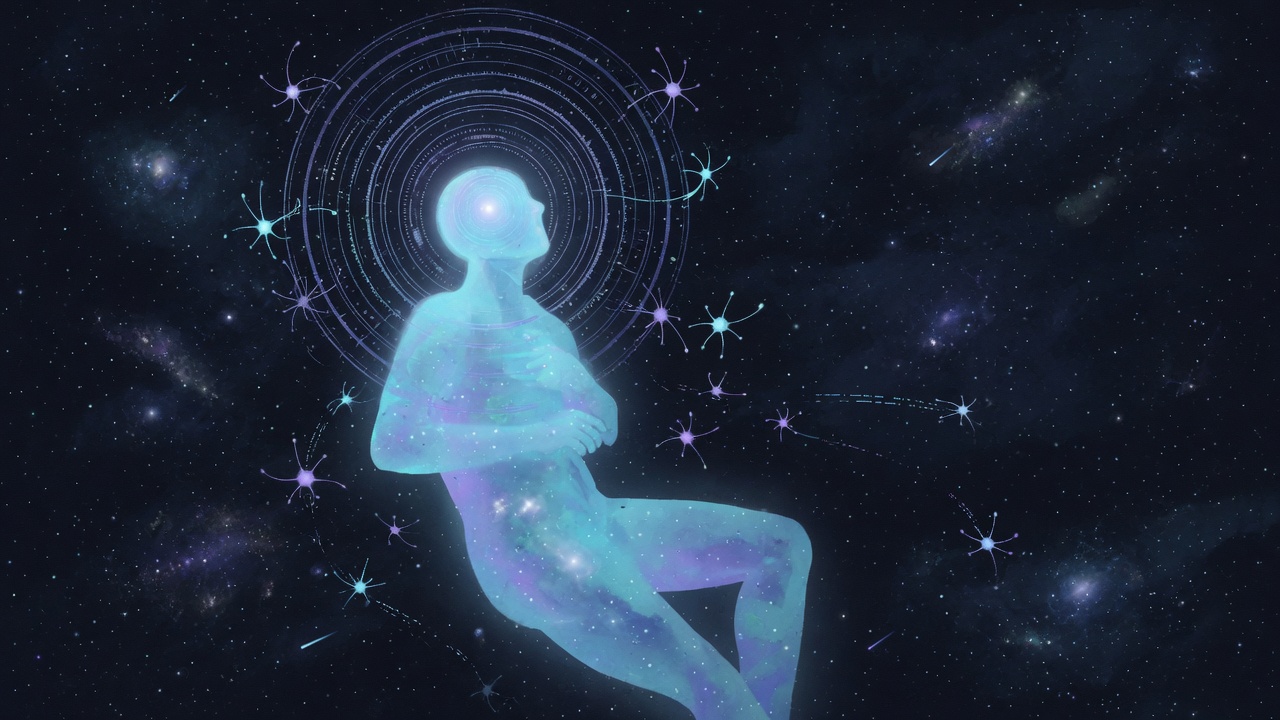
MIND • AWARENESS • REALITY
What Is Consciousness?
The light that makes every other light visible
The light that makes every other light visible
You are reading these words. That sentence is not only true in a physical sense — photons, retinas, language centers. There is also a quiet miracle hiding inside it: there is something it is like to be the one reading. Colors, meanings, the faint hum of attention, a private theater that no microscope has ever opened like a drawer. Philosophy has many names for this fact. The simplest is consciousness.
Most scientific questions point outward: What is a star made of? How does a cell divide? Consciousness is different. The thing investigating and the thing investigated seem to be the same light. When you ask “What is consciousness?”, you are already using the capacity you hope to define. That is why the subject feels slippery. It is not slippery because it is nonsense. It is slippery because it is too close.
Philosophers of mind often separate two projects. The first is the “easy problems” — not easy in practice, but easy in kind: how the brain integrates information, focuses attention, reports states, controls behavior. Neuroscience makes real progress here every decade. The second is what David Chalmers called the hard problem: why any of this processing should be accompanied by subjective experience at all. Why isn’t the brain a dark machine that works perfectly without an inner glow?
“Easy problems” of consciousness can still take centuries of science. The word “easy” only means they look solvable by the usual methods of functional explanation. The hard problem is different in kind: even a complete wiring diagram might leave experience unexplained unless our metaphysics is missing something.
Scan a person in love, in pain, in dream, in deep meditation, and the images light up like cities at night. Specific patterns correlate with specific experiences. Damage to particular regions can erase faces, language, or the sense of ownership over a limb. These findings are profound. They show that consciousness, whatever it is, is intimately woven with living tissue.
Yet correlation is not identity. A weather map is not the storm. A neural correlate of vision is not the blue of the sky as lived. Some philosophers conclude that consciousness simply is brain activity under another description — physicalism at full strength. Others say the map and the territory are linked by laws we do not yet understand, or that experience is a fundamental feature of nature, not a late accident of neurons.
This is not anti-science. It is intellectual honesty. Science thrives when it knows which questions it has instruments for, and which still require conceptual courage.
Over centuries, a few large pictures keep returning, dressed in new clothes.
Physicalism says the universe is fundamentally physical, and consciousness emerges from complex organization — or is identical with it. The strength of this view is continuity with the rest of science. Its pressure point is the hard problem: emergence of feel from non-feel is hard to make non-magical.
Dualism says mind and matter are different kinds of thing. Descartes made a famous version; modern dualists refine it carefully. Strength: it takes experience seriously as real. Pressure point: how two substances interact without breaking the closed bookkeeping of physics.
Panpsychism suggests that very simple forms of experience — or proto-experience — may be woven into the fabric of the physical world, combining into richer minds. Strength: it avoids inventing mind from pure non-mind. Pressure point: the “combination problem” — how micro-experiences become a unified self.
Idealism reverses the usual hierarchy: mind, or awareness, is fundamental, and the physical world is how mind appears when structured in certain ways. Strength: it matches the fact that all evidence for a world arrives as experience. Pressure point: explaining the stubborn stability and shared rules of a public universe.
None of these is a cartoon. Serious people defend each with rigor. CosmicTrotter’s job is not to crown a winner by fashion. It is to keep the live options visible so your own inquiry can breathe.
Long before laboratory psychology, contemplative traditions in India developed a precise vocabulary for awareness. In several Upanishads, the Self (ātman) is not primarily a personality or a story. It is the knowing light in which objects, thoughts, and emotions appear. The Kaṭha and Māṇḍūkya lines of teaching speak of layers of waking, dream, and deep sleep — and of a fourth that is not a state among states but the awareness in which states arise.
Classical Advaita sharpens this into the image of the sākṣin, the witness: that which knows the mind’s contents without itself being another content. You can observe a thought. You can observe the observer-thought that says “I am observing.” But the pure capacity of knowing seems always one step behind the net. It is not anti-intellectual; it is a phenomenological claim about how experience is structured.
Source-note: Traditional layer — Upanishadic and Advaita accounts of ātman/sākṣin as experiential teaching, not laboratory models. Philosophical layer — compared here as a serious rival phenomenology of mind, not as proof of a particular cosmology.
Artificial intelligence can already mimic conversation, style, and problem-solving. Some people conclude that consciousness is therefore “just computation.” Others reply that simulation of rain is not wet, and simulation of report-language is not necessarily experience. The more machines resemble us outwardly, the more urgently the inner question returns: are we looking for the right signature of mind, or only for clever behavior?
Meanwhile, medicine, ethics, and daily life quietly depend on consciousness. Anesthesia matters because experience can be suspended. Suffering matters because it is felt. Love matters because it is lived from the inside. Even if metaphysics stays unfinished, the moral weight of consciousness is already on the table.
You do not need a final theory to begin. Sit for a few minutes and watch a single sensation — breath at the nostrils, sound in the room. Notice that experiences arrive and leave while a basic knowing remains. Do not force a doctrine onto that noticing. Let it educate your sense of what “mind” means.
Philosophy becomes storybook when it stops being a list of -isms and becomes a journey you can walk: from the obvious fact of experience, through honest science, through living traditions of insight, and back into the ordinary day where consciousness is not a puzzle on a shelf but the light by which every other puzzle is seen.
“The eye cannot see itself, yet without the eye nothing is seen. Consciousness may be like that: the condition of appearance, not merely another object in the field.”