OBSERVATION • REALITY
The Witness and the Wave
When Looking Changes What Is Real
When Looking Changes What Is Real
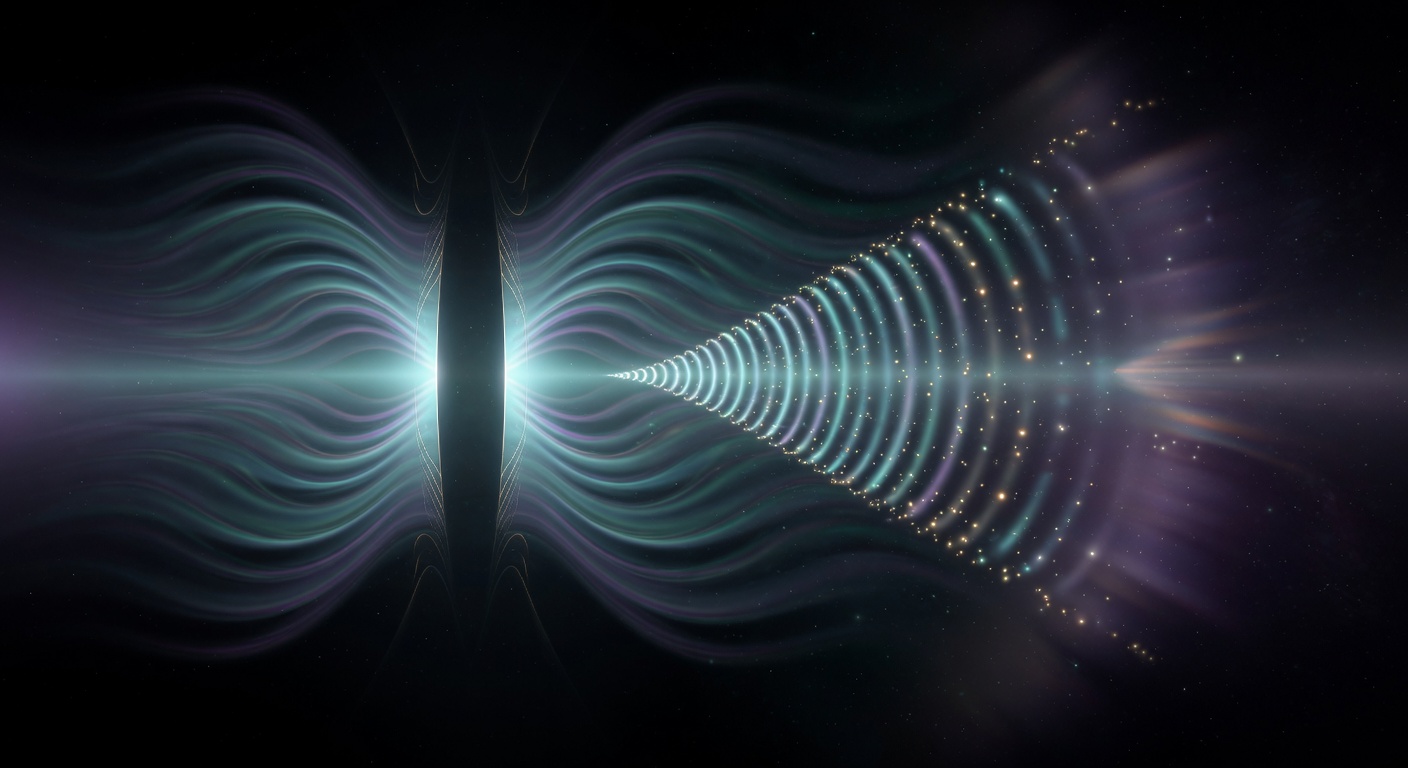
The double-slit experiment is the most famous demonstration that the quantum world refuses to behave like everyday objects. Fire electrons at a barrier with two narrow slits. Behind the barrier, a screen lights up with bright and dark bands — an interference pattern. Waves from both slits are overlapping and canceling.
Send the electrons one by one, so that only a single electron is in the apparatus at any moment. The interference pattern still builds up over time. Each electron somehow “knows” about both slits.
Now place a detector that can tell which slit the electron passed through. The interference disappears. The pattern becomes two simple clumps — as if the electrons were tiny bullets choosing one slit or the other. The mere possibility of knowing the path changes how the electron behaves.
In certain “delayed choice” versions of the experiment, the decision whether to measure which-path information can be made after the electron has already passed the slits — and the result still changes. It is as if the electron retroactively decided whether it was a wave or a particle based on a measurement made in its future.
In the Mandukya and other Upanishads, consciousness is not a product of the brain or a late arrival in the universe. It is the ground in which all phenomena appear. The “seer” (drashta or sakshi) is that which is aware of thoughts, sensations, and the world — yet is never itself an object that can be seen.
The world of multiplicity (the “ten thousand things”) arises and is experienced only in the presence of this witnessing awareness. Without the light of consciousness, there is no “world” in the sense of something appearing.
This is not a claim about electrons or measurement devices. It is a claim about the nature of experience itself: manifestation and witnessing are not two separate events. One does not happen without the other.
Quantum mechanics does not prove the Upanishads, nor do the Upanishads explain the double-slit experiment. What they offer together is a richer question: What if “observation” in physics is pointing toward something more fundamental than we usually assume — not just a conscious human looking, but the very fact that something is registered, known, or interacted with at all?
Some physicists (Wigner, von Neumann in certain interpretations, and more recent thinkers) have taken the role of consciousness in quantum mechanics seriously. Others insist the “observer” can be any physical interaction. The debate remains open at the deepest level.
Regardless of where the physics ultimately lands, the experiments invite a shift in how we experience our own attention:
“The next time you notice yourself truly seeing — really present with what is in front of you — remember the electron that waited, in some sense, to be met before it decided what it would be.”
The double-slit experiment remains the clearest demonstration that the quantum world does not behave like classical objects. The decision to look — or the possibility of looking — changes the pattern that appears.
From Young’s 1801 light experiment, through Davisson-Germer electron diffraction, to single-particle versions and the quantum eraser (Scully et al.), the core mystery persists: the electron seems to explore both paths until information is available about which path it took.
Delayed-choice versions (Wheeler’s thought experiment realized) make the situation even stranger — the “choice” of whether to obtain which-path information can be made after the particle has passed the slits, and the statistics still reflect the choice.
Copenhagen, Many-Worlds, QBism, Penrose’s objective reduction, and others differ precisely on the status of the “observer” or measurement. Some push consciousness out; others bring it back in at the fundamental level. The question is not settled.
The Mandukya Upanishad is only 12 verses yet is considered the essence of Vedanta. It maps AUM to the three states of consciousness and the silence to turiya — the pure witness that underlies and is untouched by waking, dreaming, and deep sleep.
The sakshi is that which knows all experience but is never itself an object of experience. In some readings, the world of name and form (nama-rupa) arises in the light of this awareness.
The physics and the contemplative traditions meet at the question: what is the minimal condition for something to “show up” as real?