DEEP DIVE • HINDU WISDOM
The Upanishads
The First Cosmic Manuals
The First Cosmic Manuals
The rishis of ancient India asked the deepest questions through direct realization: What is the nature of reality? What am I? What is the universe made of? What is the Self?
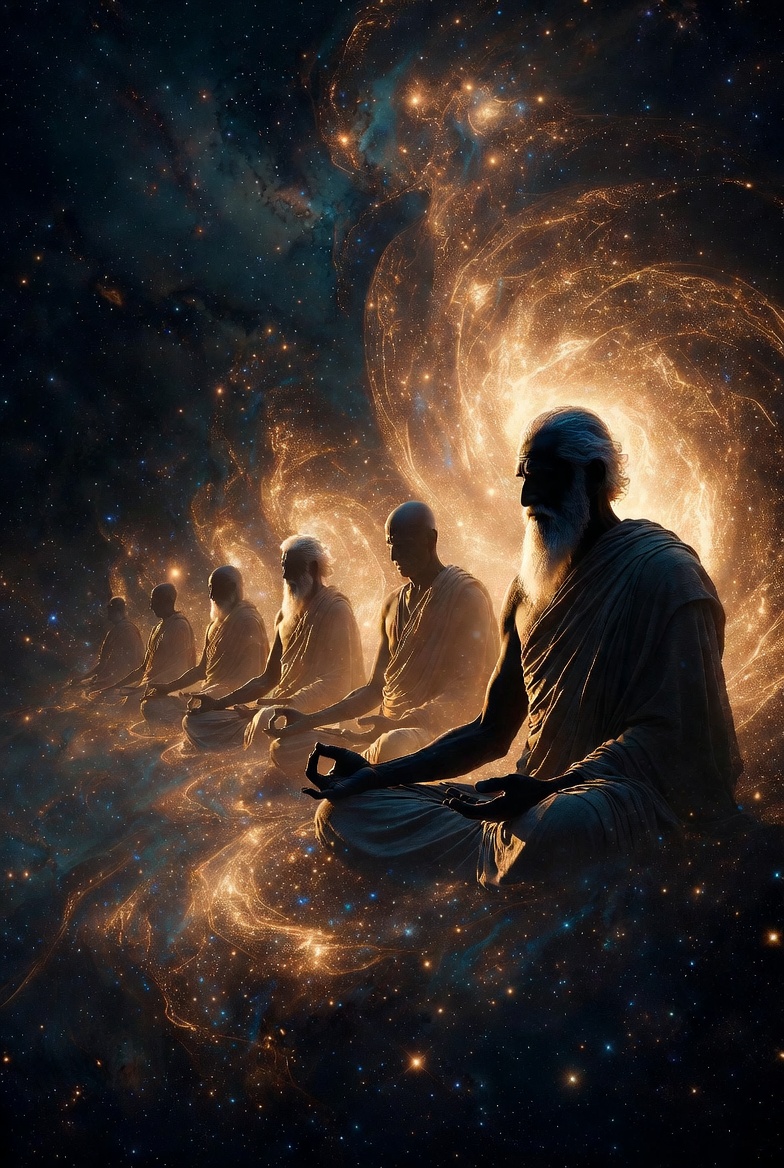
The word Upanishad literally means “sitting near” — sitting near a teacher to receive the highest knowledge. These texts, composed between 800–200 BCE, form the philosophical core of Hinduism and are considered the culmination of Vedic thought (Vedanta).
While the earlier Vedas focused on rituals and hymns, the Upanishads turned inward. They asked: What is the essence behind all rituals? What is the true Self? What is the ultimate reality?
The most revolutionary idea in the Upanishads is the declaration: “Tat Tvam Asi” — “Thou art That.”
This means the individual self (Atman) is not separate from the ultimate reality (Brahman). The same consciousness that animates you is the same consciousness that pervades the entire universe.
This is not poetry. This is the first clear statement in human history that consciousness is fundamental — not matter. Modern physics is only now catching up with this ancient insight.
Read the complete detailed exploration of the Upanishads — with key verses from the major Upanishads, core philosophical concepts (Atman, Brahman, Maya), practical meditation and self-inquiry techniques, and guidance for the spiritual seeker.
Read the Full Deep Article~1,200 words • 7 min read
Brahman is described as sat-chit-ananda — Existence-Consciousness-Bliss. It is not a person or a god in the usual sense. It is the ground of all being, beyond name and form, yet the source of all names and forms.
The Upanishads teach that the world of multiplicity we experience is Maya — not that it is unreal, but that it is not the ultimate reality. Just as a dream feels real while we are dreaming, the world of names and forms feels solid until we wake up to our true nature.
In every age, the Upanishads offer something no other ancient text does: a complete map of consciousness.
They tell us that the deepest questions of existence — Who am I? Why am I here? What is the universe? — cannot be answered by studying the outside world alone. We must turn inward.
As the Katha Upanishad says: “The self-existent Lord pierced the senses to turn outward. Therefore, one looks outward, not within oneself. A rare seeker, desiring immortality, turns his eyes inward and sees the Self within.”
“The Upanishads are the first great attempt in human history to understand the nature of reality through direct experience rather than belief.”
— Modern interpretation