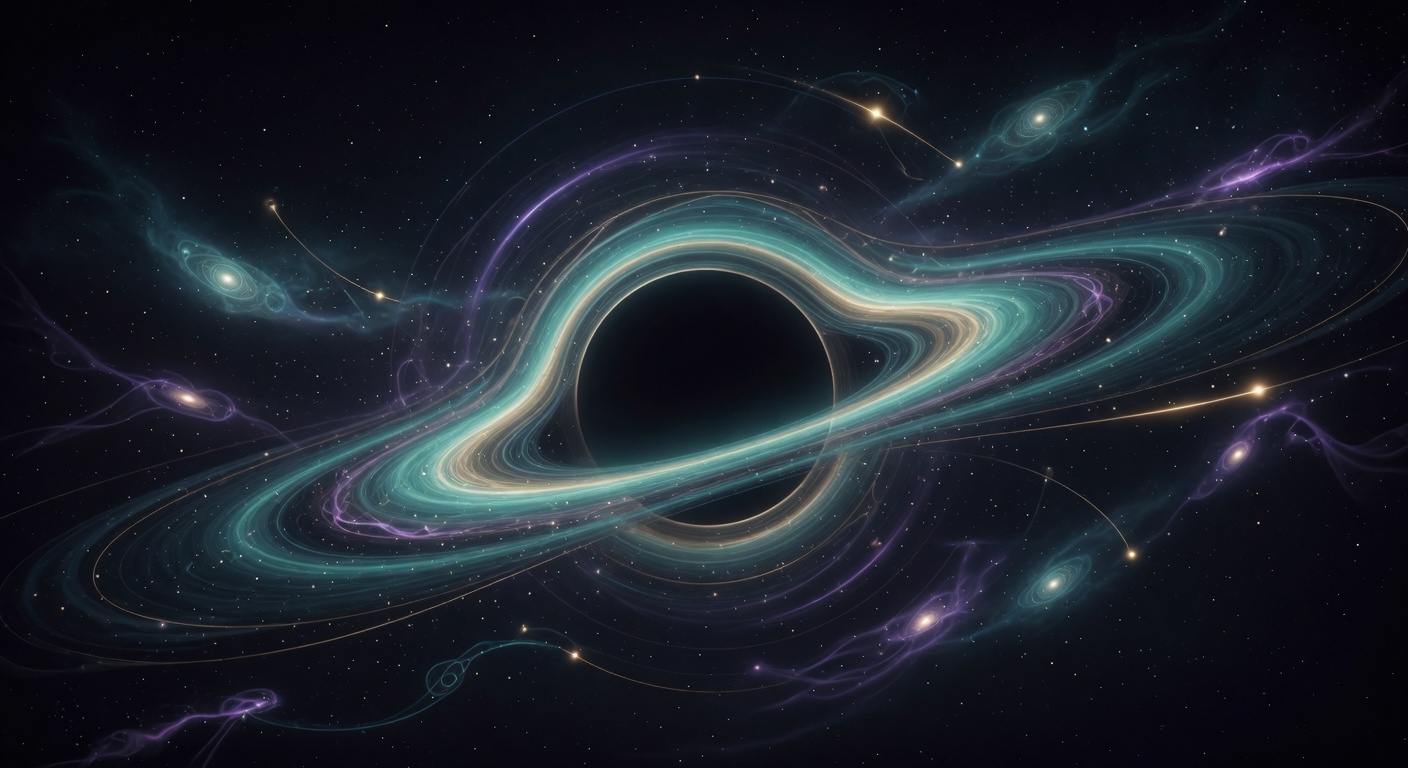
BLACK HOLES • TIME
At the Edge of Forever
Where Time Stops and Form Returns to Mystery
Where Time Stops and Form Returns to Mystery
Imagine you are falling toward a supermassive black hole. At first the ride is almost peaceful. The event horizon — the point of no return — is invisible. You cross it without fanfare.
Once inside, the geometry of spacetime itself changes. Every possible path leads toward the center. There is no “out.” Light itself cannot escape. From your viewpoint, the universe outside ages at an accelerating rate. Stars burn through their fuel in what feels like minutes. Galaxies collide and die. The entire future of the cosmos plays out in your final moments.
Then the tidal forces become unbearable. Your feet are pulled much more strongly than your head. You are stretched — spaghettified — into a long thin stream of particles. Finally, at the singularity, the curvature of space becomes infinite. Our current physics breaks down. We do not know what happens to the information that was “you.”
If you fell into a stellar-mass black hole, the tidal forces would tear you apart long before you reached the center. But for a supermassive black hole like the one at the center of our galaxy, you could cross the horizon intact and only feel the stretching in the final moments. Size changes everything.
The Puranas and Vedas describe pralaya — the dissolution at the end of a cosmic cycle. Worlds, gods, and beings are drawn back into the unmanifest. Form returns to potential. Time itself is said to “sleep.”
This is not portrayed as punishment or tragedy. It is the necessary inhale after the exhale of creation. The same texts that celebrate the glory of manifestation also honor the return to the formless as sacred and inevitable.
There is a haunting parallel. In the black hole, matter and energy are compressed beyond recognition. Information is (according to some theories) preserved on the surface in some encoded way, while the interior appears to erase distinctions. The language is different, but the intuition of “form dissolving back into something more fundamental” appears in both domains.
Black holes are not just distant curiosities. They are the most extreme laboratories we know for the nature of time, information, and the limits of reality.
For a human being they offer a stark meditation:
“When everything you thought was solid begins to stretch and the future rushes past faster than you can grasp, remember: even the universe practices this kind of surrender at its most extreme edges.”
Imagine you are falling toward a supermassive black hole at the center of a galaxy. From far away, your colleagues watch your image slow down, redden, and eventually freeze at the invisible boundary called the event horizon. You never appear to cross it. Your last photons linger forever in their view, stretched into the infinite future.
But from your own frame, the crossing is uneventful at first. The horizon is not a wall of fire or a tangible surface for large black holes. It is a point of no return in the causal structure of spacetime. Once inside, all future light cones tilt inward. There is no trajectory that leads back out.
As you fall deeper, the tidal forces grow. For a stellar-mass black hole the stretching (spaghettification) would kill you before the horizon. For a supermassive one like Sagittarius A*, you can pass the horizon with only gentle gradients initially. The real violence happens very near the center.
Time behaves strangely. To a distant observer your clock slows without limit. To you, the outside universe ages at an ever-increasing rate. Stars exhaust their fuel, galaxies merge, the cosmic microwave background cools into nothing. The entire future of the universe can unfold during your final proper seconds as you approach the singularity.
In the coordinate systems used by distant observers (Schwarzschild coordinates), the horizon is at a fixed radius, but for the infaller it is crossed in finite time. The mathematics shows that the “freezing” is an artifact of the coordinate choice, not a physical barrier for the one falling in. This coordinate dependence is central to many paradoxes in black hole physics.
In 1974 Hawking showed that quantum fields near the horizon produce particles that escape to infinity as thermal radiation. The black hole loses mass and eventually evaporates. This is not controversial. What is deeply controversial is what this implies for the information that fell into the black hole.
Quantum mechanics is unitary — information is conserved. If the black hole evaporates completely into thermal radiation, the detailed information about what fell in appears lost. This is the black hole information paradox. It has driven decades of research in quantum gravity, holography, and the nature of spacetime itself.
Current leading ideas (as of 2026) include:
No consensus yet, but the direction is that information is not destroyed; our classical picture of the interior as a separate region that can be “lost” is incomplete.
The Puranas describe the end of a cosmic cycle (pralaya) in terms that feel eerily parallel. At the close of a kalpa, seven suns blaze simultaneously, the oceans evaporate, wind and fire consume the remains, and the three worlds are reduced to a single ocean. Then the subtle elements withdraw into the unmanifest.
Kala (Time) is repeatedly personified as the great devourer. In the Bhagavata Purana and Mahabharata, Kala is that which brings all beings — even the gods — to their appointed end. Yet this is not nihilistic. It is the necessary return so that a new cycle can emerge.
The structural similarity is striking: in both the black hole and pralaya, distinctions of form are erased. Matter and energy are compressed or dissolved beyond ordinary recognition. The question of whether “information” (in the modern sense) or the seeds of the next creation are preserved is left open in both pictures.
This is not an isolated mystery. In the deep exploration of the breathing cosmos, we saw how cyclic models replace a singular beginning with rhythmic bounces and aeons. A black hole can be viewed as a local, extreme version of the same process — a region where the future of one “aeon” is compressed and potentially seeds new structure.
In Worlds Without Number, the Puranic vision of innumerable Brahmandas finds a modern echo in the possibility that black holes themselves might spawn new universes (in some speculative models). The “countless worlds” are not only out there among the stars; they may be nested inside horizons.
The Rishis Who Measured the Stars cultivated attention across generations to track subtle regularities in the sky. Near a black hole, time dilation makes “generations” pass in what feels like moments to the infaller. The rishis’ patient, multi-kalpa gaze is the perfect counterpoint to the extreme time compression at the horizon.
Identify one major threshold you have crossed or are approaching (a diagnosis, a divorce, a career change, a profound loss, a spiritual awakening). Write two versions: (a) how it looks from “outside” (frozen, final, the end of the story), and (b) how it might feel once crossed (the outside world rushing forward, old forms dissolving). Sit with the difference.
Practice a 10–15 minute meditation where you deliberately slow your sense of time. Use breath or a mantra. At the end, reflect: what “future” rushed past while you were “inside” the practice? What old identifications dissolved?
Consider what “information” about you (memories in others, creations, DNA, stories) would survive your personal “evaporation.” What would be lost? The exercise is not morbid; it is clarifying. Many traditions suggest that what truly matters is never lost, only transformed.
Whether we speak in the language of Hawking radiation and islands or in the language of pralaya and the unmanifest, the message is similar: the most extreme compression and dissolution does not necessarily mean annihilation of all that was. Something is preserved or seeded for what comes next.
The black hole does not only destroy. In some models it may be a recorder or even a womb. The ancient view does not only mourn the end of a world — it prepares the ground for the next emergence.
Both invite the same human stance: meet the horizon with eyes open, knowing that endings are real and that the rhythm continues.
“When everything you thought was solid begins to stretch and the future rushes past faster than you can grasp, remember: even the universe practices this kind of surrender at its most extreme edges — and even there, something of what was may still be carried forward.”
One of the most surprising ideas in modern theoretical physics is that the information content of a region of space may scale with its surface area rather than its volume — the holographic principle. Black hole thermodynamics was a major path into this insight: the entropy of a black hole is proportional to the area of its event horizon (the Bekenstein–Hawking formula), not to the volume inside.
If the deepest bookkeeping of reality is written on boundaries, then what is inside and what is on the surface become more intimate than everyday intuition allows. Ancient images of form dissolving into an unmanifest ground do not prove holography. They train the mind to hold dissolution without panic — a useful companion to equations that still leave the final fate of information unfinished.
Honesty note: holography and the information paradox remain active research. This page pairs physics consensus where it exists with open questions and traditional metaphors — not secret equivalences.