DEEP DIVE • OBSERVATION & CONSCIOUSNESS
The Witness and the Wave
Measurement, Manifestation, and the Ancient Science of Awareness
Measurement, Manifestation, and the Ancient Science of Awareness
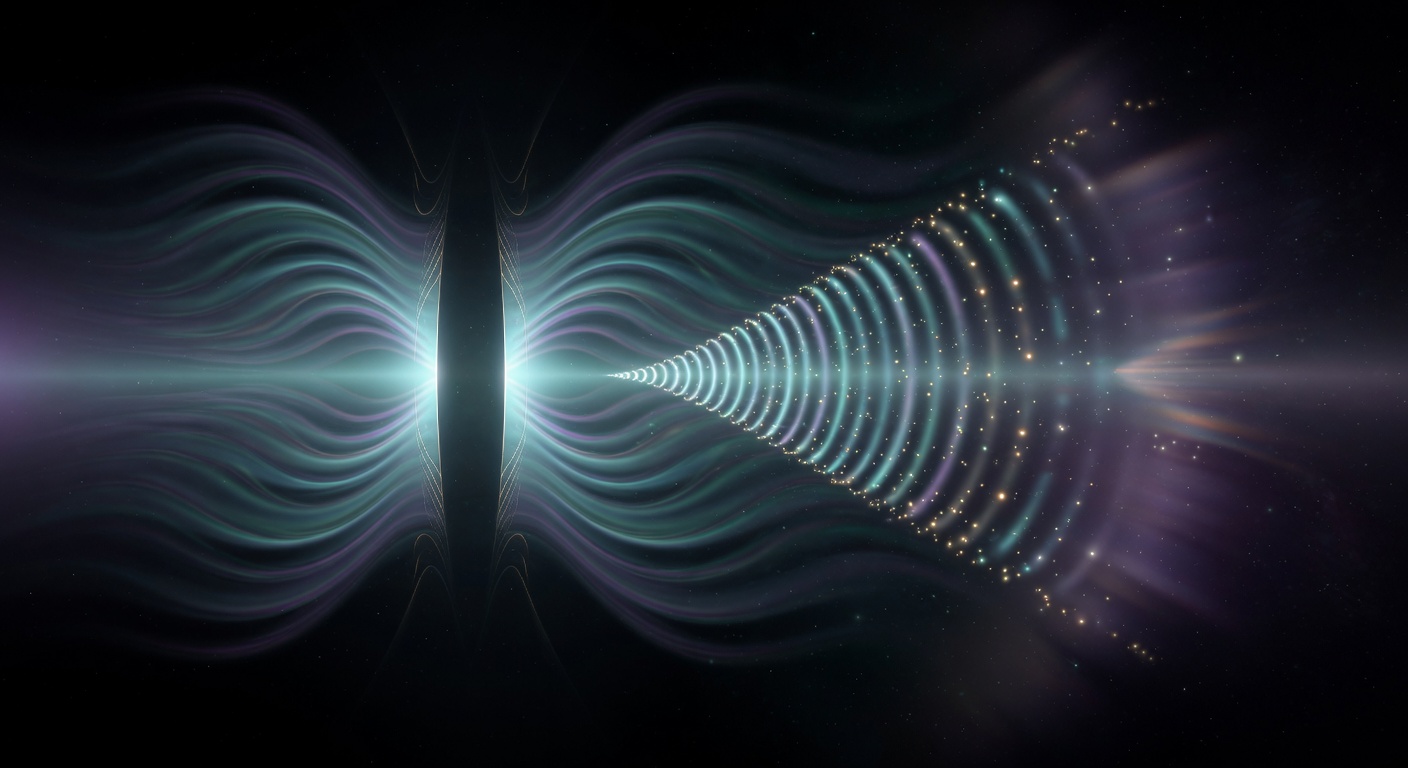
The double-slit experiment remains the clearest demonstration that the quantum world does not behave like classical objects. The decision to look — or the possibility of looking — changes the pattern that appears.
From Young’s 1801 light experiment, through Davisson-Germer electron diffraction, to single-particle versions and the quantum eraser (Scully et al.), the core mystery persists: the electron seems to explore both paths until information is available about which path it took.
Delayed-choice versions (Wheeler’s thought experiment realized) make the situation even stranger — the “choice” of whether to obtain which-path information can be made after the particle has passed the slits, and the statistics still reflect the choice.
Copenhagen, Many-Worlds, QBism, Penrose’s objective reduction, and others differ precisely on the status of the “observer” or measurement. Some push consciousness out; others bring it back in at the fundamental level. The question is not settled.
The Mandukya Upanishad is only 12 verses yet is considered the essence of Vedanta. It maps AUM to the three states of consciousness and the silence to turiya — the pure witness that underlies and is untouched by waking, dreaming, and deep sleep.
The sakshi is that which knows all experience but is never itself an object of experience. In some readings, the world of name and form (nama-rupa) arises in the light of this awareness.
The physics and the contemplative traditions meet at the question: what is the minimal condition for something to “show up” as real?