TIME • CHANGE • IDENTITY
Time, Change, and Permanence
What flows, what endures, and what we are in between
What flows, what endures, and what we are in between
You will never meet a day that stays. Hair greys, empires fall, stars exhaust their fuel, and yet something in you wants a fixed point — a name, a vow, a truth that does not dissolve. Philosophy of time is not only about clocks. It is about how to love a world that will not sit still.
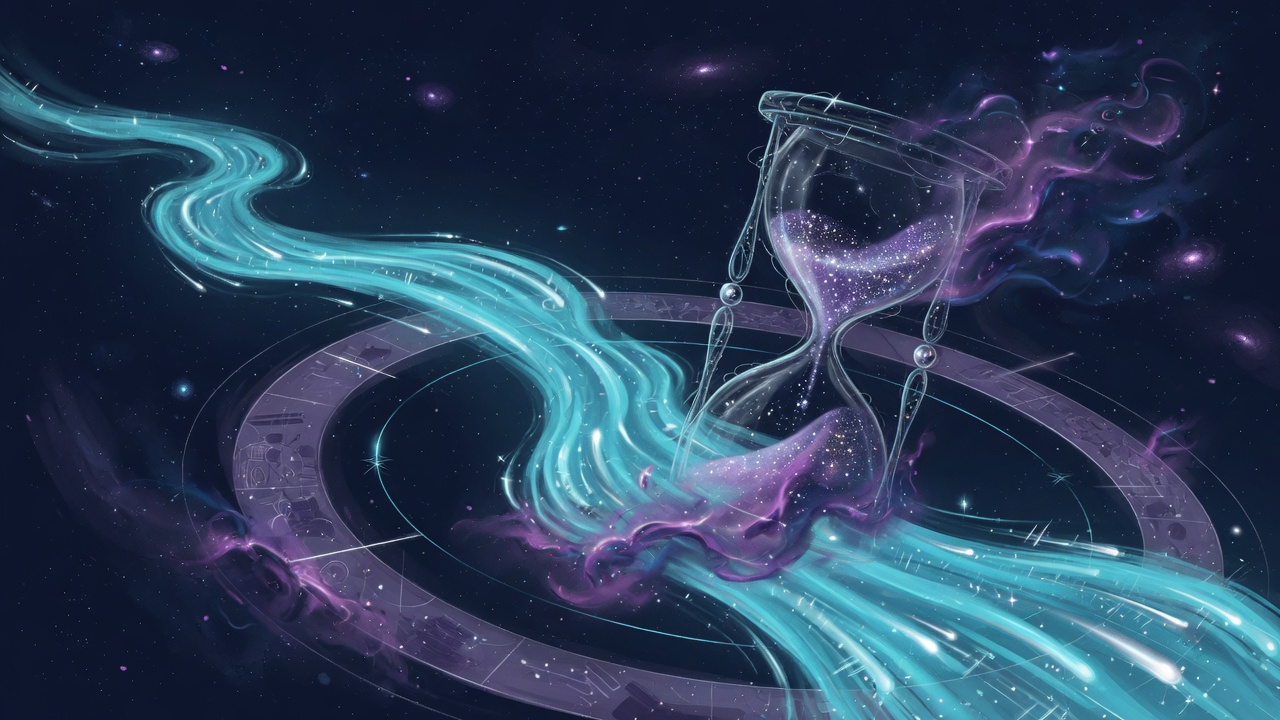
Common sense pictures time as a river: the past is gone, the future is open, the present is the boat. Some metaphysical pictures instead describe a “block” in which all events simply are, and our sense of flow is how consciousness travels the structure. Both images have costs. The river struggles with physics’ symmetry talk. The block struggles with the urgency of choice and the asymmetry of memory.
You do not need to crown a final theory tonight. You need to notice which image quietly runs your life. Panic often assumes the river is a flood. Apathy often assumes the block has already written you off.
Replace every plank of a ship one by one: is it the same ship? Replace every belief, cell, and habit over decades: are you the same person? Continuity may be memory, narrative, social recognition, and overlapping stages — not an unchanging pearl underneath.
This is merciful. It means growth is not betrayal of a frozen self. It is also demanding. It means promises are commitments across change, not magic locks that stop time.
“Now” is not a simple universal slice of the cosmos in relativity. Different observers can disagree on simultaneity for distant events. Everyday time still works; cosmic time is subtler than wristwatch intuition.
Physics gives time multiple faces: parameter in equations, proper time along a worldline, thermodynamic arrow linked to entropy’s tendency. Why memory points one way is still a deep conversation. For lived ethics, the arrow matters because consequences are not reversible like video scrubbing. Harm done is not a free undo.
Early Buddhist analysis emphasizes arising and passing of phenomena. Clinging to permanence is a root of suffering. This is not nihilism; it is precision. What is composite will change. Wisdom is meeting change without denial and without panic.
Puranic and related cyclic images of ages and cosmic breath offer another medicine: endings can be phases in larger rhythms rather than absolute annihilations. Modern cosmology’s cyclic and bounce ideas (still debated) rhyme emotionally with those older maps — without proving them.
Source-note: Philosophical identity debates + careful popular relativity/thermo ideas + Buddhist impermanence + cyclic mythic cosmology as comparative lenses, not a single proof.
Practice three tempos. Deep time: remember stars and civilizations so ego shrinks kindly. Human time: keep promises and calendars so trust can grow. Present time: feel one breath fully so life is not only preparation for a future that never arrives.
A good life is rarely one tempo only. It is a musical skill of switching.
“You are not required to stop the river. You are invited to learn how to drink from it without drowning.”