The Most Dramatic Moment in the Bhagavad Gita
After ten chapters of profound philosophy, Arjuna makes a bold request to Krishna:
"O Lord, if You think it possible for me to see Your cosmic form, then please reveal to me Your imperishable Self."
— Bhagavad Gita 11.3
What follows is one of the most awe-inspiring and terrifying revelations in all of spiritual literature — Vishwaroopa Darshan, the vision of the Universal Form.
Krishna does not just show Arjuna a beautiful divine form. He reveals the entire cosmos — past, present, and future — all contained within His body. It is a vision that leaves Arjuna trembling with fear and wonder.
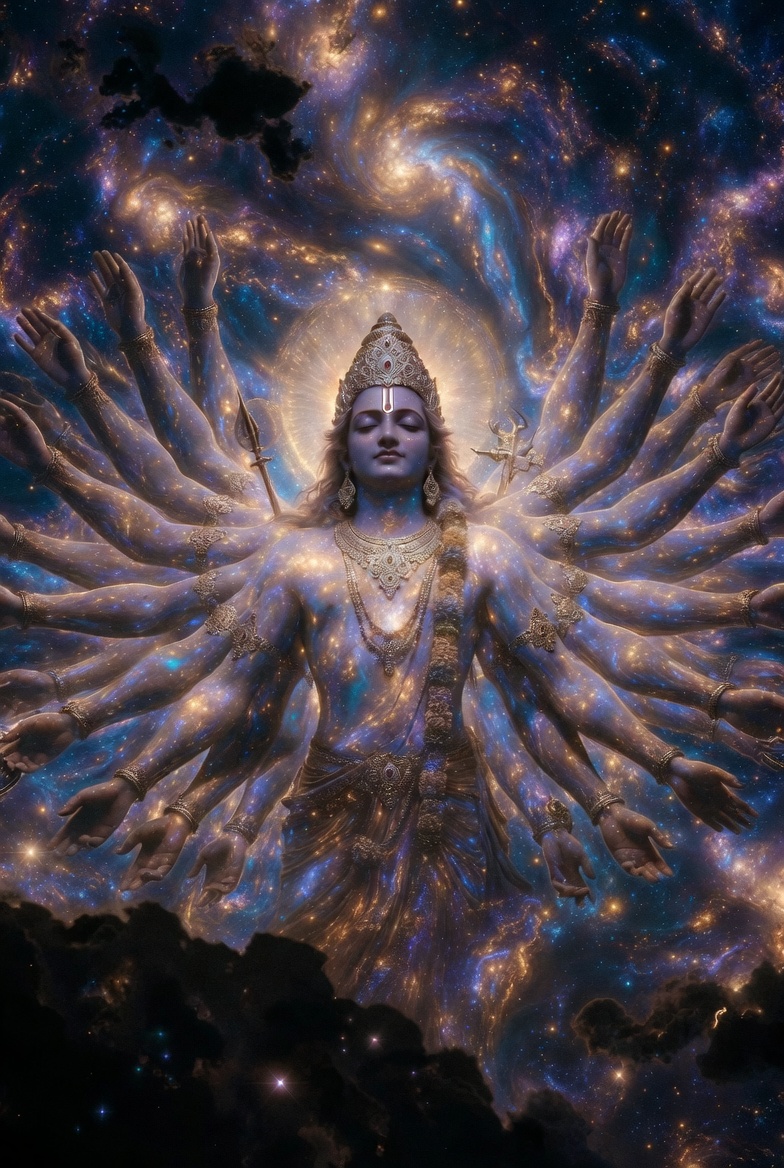
Vishwaroopa — The Infinite Cosmic Form of Lord Krishna
What Did Arjuna Actually See?
The Infinite Cosmic Body
Krishna reveals Himself as the entire universe. Arjuna sees:
- Thousands of heads, arms, and eyes — representing infinite forms and beings
- The sun and moon as His eyes
- Fire as His mouth
- All planets, stars, and galaxies moving within Him
- Past, present, and future warriors already entering His mouth to be destroyed
- Time (Kala) as the ultimate destroyer
The Terrifying Aspect
Arjuna does not just see beauty. He sees destruction. He watches all the great warriors of both armies — including Bhishma, Drona, Karna, and his own brothers — already being crushed between Krishna's teeth.
This is the most important message of Vishwaroopa: Time devours everything. No one escapes the jaws of time.
Most Powerful Verses from Chapter 11
"If the radiance of a thousand suns were to burst forth at once in the sky, that would be like the splendor of the Mighty One."
— This verse was famously quoted by J. Robert Oppenheimer after the first atomic bomb test.
"I am Time, the great destroyer of the world, and I have come here to destroy all people."
— One of the most powerful declarations in the entire Gita. Krishna identifies Himself as Kala (Time).
"He who does work for Me, he who looks upon Me as the Supreme, he who is devoted to Me, he who is free from attachment, he who is without hatred for any creature — he comes to Me, O Pandava."
— The final teaching: Only through selfless action, devotion, and equanimity can one truly see and reach the Divine.
The Deep Philosophical Meaning
1. Everything is Within God
Vishwaroopa teaches that there is nothing outside of the Divine. Every atom, every being, every event — all of it is happening inside Krishna. There is no "outside" to God.
2. Time is the Ultimate Reality
The most terrifying aspect of Vishwaroopa is the realization that Time (Kala) is God Himself in His destructive form. Everything that is born will die. This is not pessimism — it is the ultimate truth that frees us from attachment.
3. Free Will Within Destiny
Even though everything is already happening inside Krishna, Arjuna still has to fight. This is the paradox of life: we have free will, yet everything is already written. The wise person acts without attachment to results.
4. Surrender is the Only Way
After seeing the terrifying form, Arjuna completely surrenders. Vishwaroopa is not meant to scare us — it is meant to break our ego so completely that only surrender remains.
Modern Scientific & Psychological Parallels
The Infinite Form
Vishwaroopa reveals the Lord as containing all worlds, all beings, and all time within Himself. It is the vision of the cosmos as the body of the Divine — everything that exists is an expression of that one infinite form.
Black Holes & Spacetime
The image of everything being pulled into Krishna's mouth is remarkably similar to how black holes work — where space and time themselves are warped and nothing escapes. Krishna as Kala (Time) mirrors how time slows down near the event horizon of a black hole.
Psychology: Ego Death
In modern psychology and psychedelic research, "ego death" is a common experience where the sense of separate self completely dissolves. Arjuna's terror and subsequent surrender is a perfect ancient description of this psychological and spiritual process.
Practical Wisdom from Vishwaroopa
Accept Impermanence
Everything you love will eventually be taken by Time. This is not depressing — it is liberating. It frees you to live fully in the present.
Act Without Attachment
Arjuna still had to fight, even after seeing that the outcome was already decided. Do your duty with excellence, but release attachment to results.
See the Divine in Everything
After Vishwaroopa, Arjuna could never see the world the same way again. Practice seeing Krishna (the Divine) in every person, every situation, and every moment.
Surrender Your Ego
The vision completely shattered Arjuna's ego. True spiritual growth requires moments where our limited self is broken so that something greater can emerge.
Vishwaroopa Meditation Practice
Here is a powerful 15-minute visualization practice based on Vishwaroopa:
Vishwaroopa is not just a story.
It is an invitation to see the Divine in everything — including the terrifying and the temporary.
"I am Time, the great destroyer of the world."
When you truly understand this, you become free.